
 citysuburbinc
📌 Key Takeaways
Choose the decision that preserves asset value, not the bid that only looks good today.
Compatibility Over Hardness: On historic brick, modern cement mortar is a liability while lime-based mixes align with how the wall breathes and moves.
Let Joints Sacrifice, Not Brick: Mortar must be weaker and more permeable than the units so stress and moisture dissipate in the joints—not inside the brick.
Prove It Before You Approve It: Require mortar analysis, a small test panel, and agreed joint tooling to validate color, permeability behavior, and performance.
Think Lifecycle, Not Day One: Correct mortar matching reduces moisture-driven failures, spalling, and emergency facade work, stabilizing multi-year budgets.
Turn Insight Into Policy: Use a simple comparison framework to standardize approvals so every project favors material compatibility and portfolio resilience.
Protect the wall, the budget, and your reputation—choose compatibility first.
Too tempting, right?
A contractor slides a low bid across the table. The scope reads like a miracle cure—“repointing with a harder, stronger mix for durability.” The room quiets; a tenant complaint is waiting; the owner wants it cheap.
For Brooklyn property managers, this moment is familiar. The quote looks great on paper—until it isn’t. The risk isn’t cosmetic. It’s structural, financial, and reputational.
Imagine the alternative. The same facade three winters from now: dry walls, intact parapets, no emergency scaffolding, and a board packet that shows you chose the conservative, standards-aligned path. That’s where this guide points.
Strategic pull-quote: “Using modern mortar on a historic brick building doesn’t strengthen it—it can permanently destroy the original brick.”
The All-Too-Common Myth: “Stronger Mortar Is Always Better”
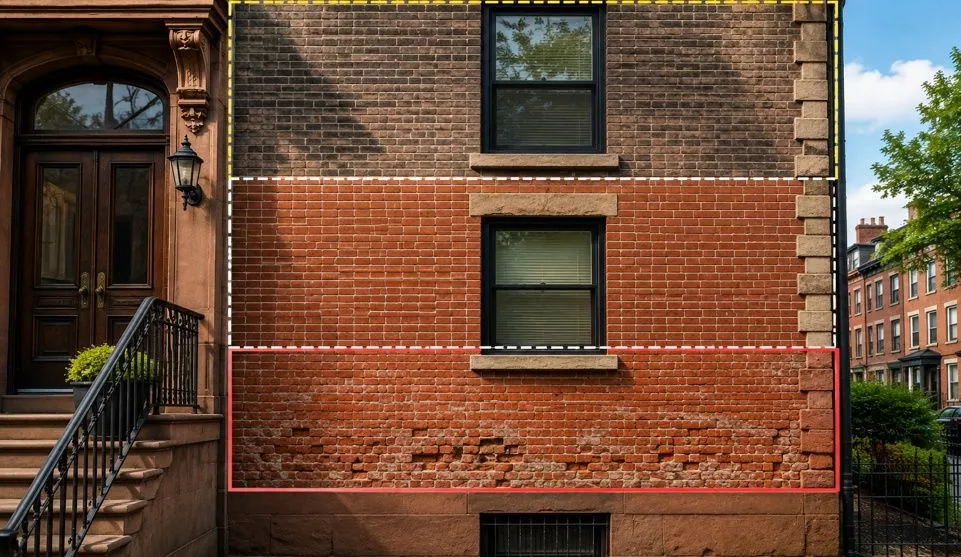
Low bids often rely on modern, hard, cement-rich mortar because it sets fast and looks crisp on day one. That’s the myth. On historic brick—common across Brooklyn’s pre-war building stock—hard mortar can force the brick to absorb movement and moisture the joint should be handling. The result isn’t durability; it’s damage.
Historic masonry systems were designed to breathe and deform slightly. Lime-based mortars accommodate that behavior; cement-rich mortars resist it. In practice, that mismatch transfers stress into softer historic brick, a pathway to cracking and spalling.
Explicit triple (for clarity and planning): Building facade restoration in Brooklyn reduces the likelihood of future parapet wall repair by managing water and movement at the joints—where the system was designed to handle it.
Business takeaway: A low initial price can mask a high liability curve: hidden moisture, freeze–thaw damage, and unplanned capital work later.
Brick Pointing in Brooklyn • Why the Right Mortar Mix is Everything for Historic Brooklyn Brick
The Reality: How Modern Mortar Can Destroy Historic Brooklyn Brick
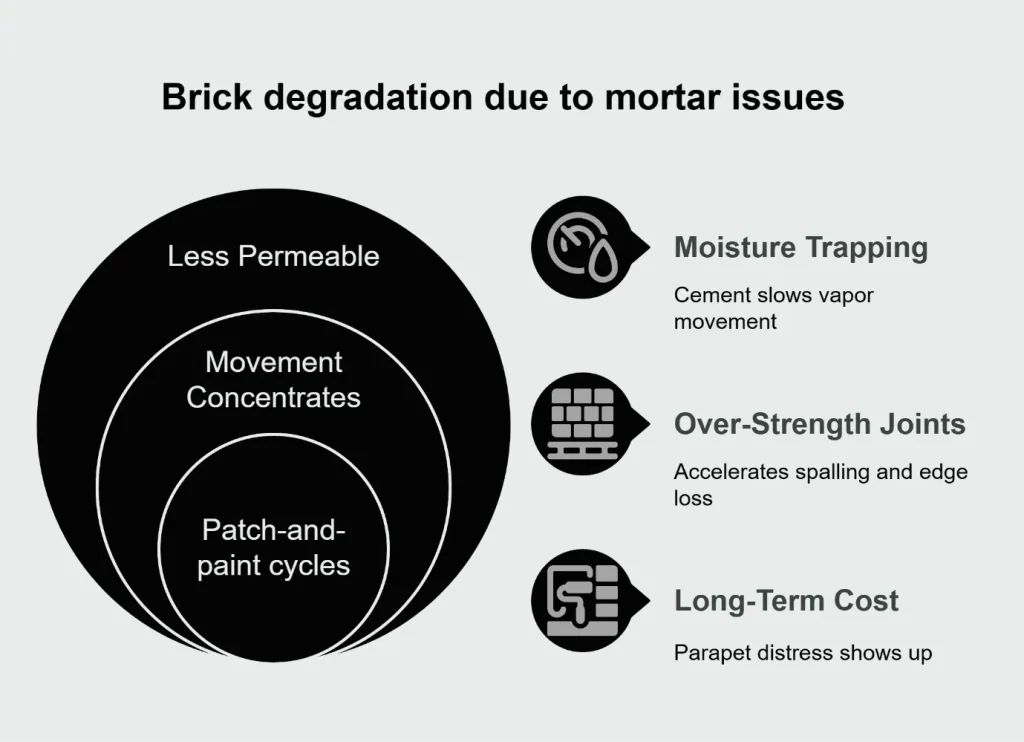
The mechanism isn’t mysterious; it’s material science and building physics. Three pathways matter most.
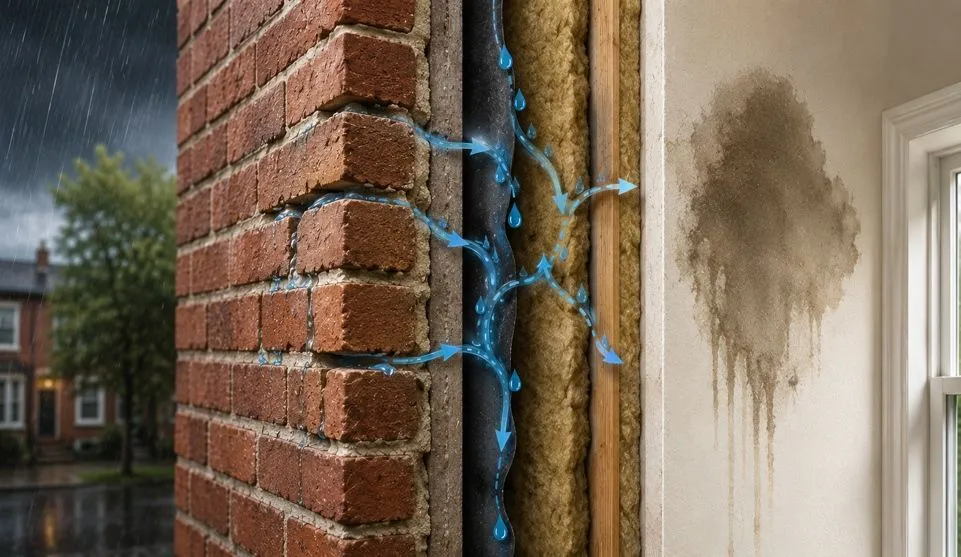
Trapping Moisture: Low Permeability Creates Wet Walls
Cement-rich mortars are less permeable. On older brick, that often slows vapor movement through the joint. Moisture lingers in the wall, raising the risk of salt crystallization and freeze–thaw cycling. Over time, faces “pop,” edges crumble, and hairline cracks open the way for water. On historic fabric, a more permeable lime-based mortar is favored to vent moisture safely.
External reference: National Park Service, Preservation Brief 2 (guidance on repointing historic masonry) — a widely relied-upon standard for conservation-grade work.
National Park Service Preservation Brief 2
Over-Strength Joints: When the Mortar Is Stronger Than the Brick
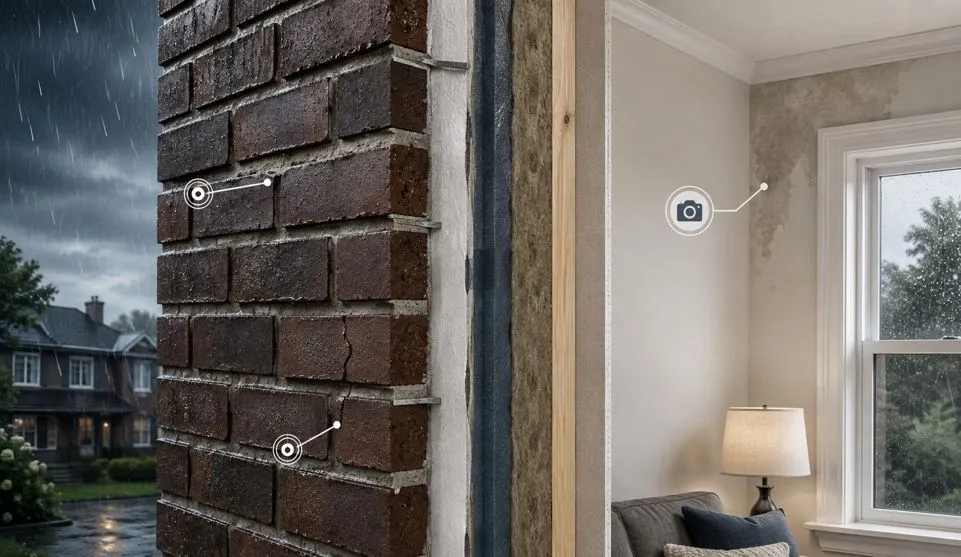
Mortar should be the sacrificial element. If the joint’s compressive strength and stiffness exceed the brick’s, movement concentrates in the unit, not the joint. That flips the system’s design logic and accelerates spalling and edge loss.
Note: Some early-20th-century buildings were built with stronger mortars; matching still hinges on analysis of the existing fabric, not a default to “harder is better.”
The Long-Term Cost: Spalling, Facade Cycling, and Emergency Work
Water-trapped, over-stressed walls rarely fail on schedule. They fail after the cheap job is closed. That’s when patch-and-paint cycles, tile-like delaminations, and parapet distress show up—none of which were priced into that low bid. A current leading practice is to treat mortar analysis and test panels as standard due diligence on historic fabric so that lifecycle costs are understood before approving a scope.
A Clear Comparison: Modern Cement Mortar vs. Historic Lime-Based Mortar
Direct answer first: On historic brick facades typical across Brooklyn, lime-based mortar is generally the safer, system-compatible choice; modern cement mortar introduces permeability and strength mismatches that can drive long-term damage.
Modern vs. Historic Mortar: Key Differences in Permeability, Strength, and Cost
City Suburb point of view: Quick wins rarely win. Material compatibility is the controlling variable for facade longevity.
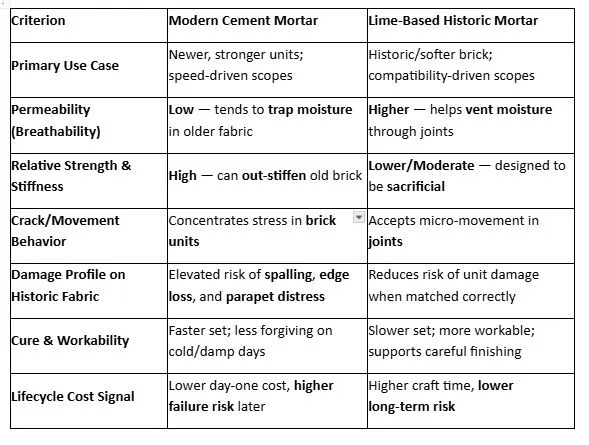
Definitions inside this asset:
- Permeability = a material’s ability to let water vapor escape.
- Sacrificial joint = mortar deliberately weaker/softer than brick so the joint takes wear, not the unit.
Outcome sentence: Use this table to brief owners: matching the mortar to the brick protects the asset, reduces emergency work, and supports predictable capital planning.
External references for the above principles:
3 Key Risks of Improper Mortar
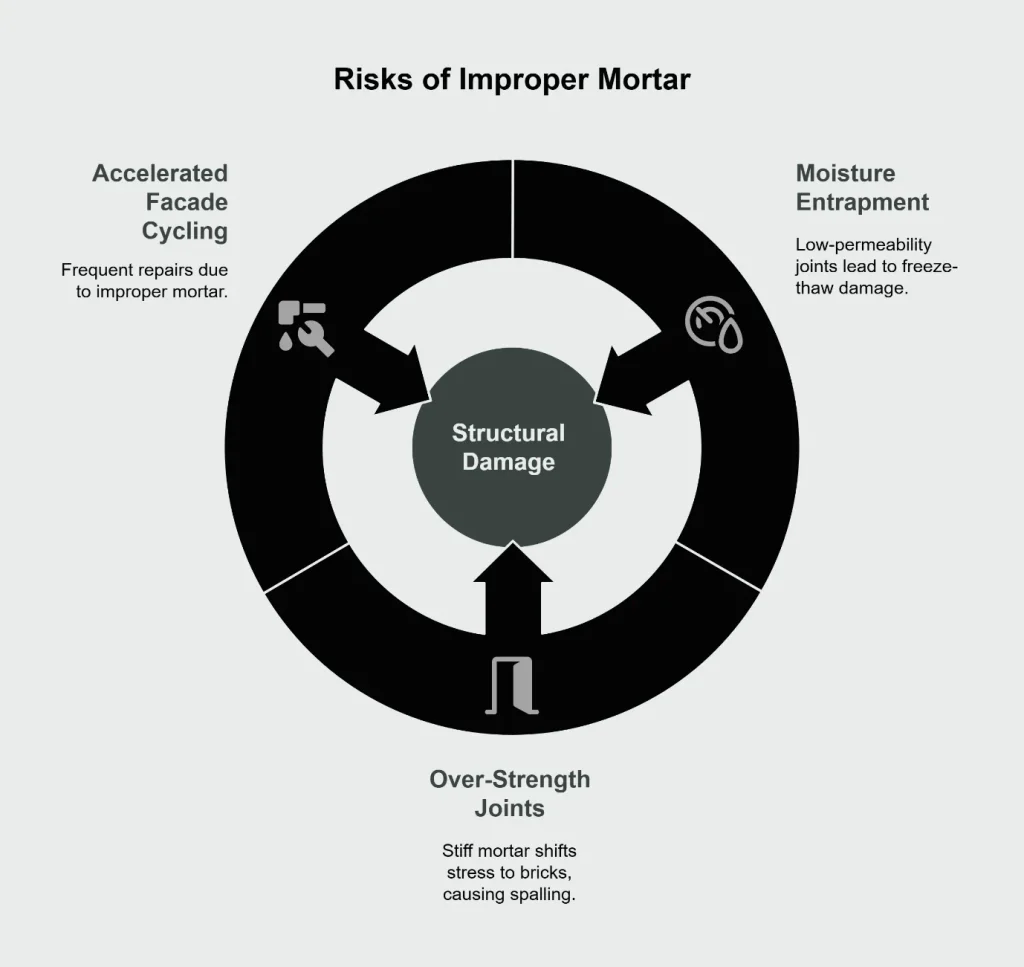
- Moisture Entrapment → Freeze–Thaw Damage. Low-permeability joints slow drying, raising the likelihood of face pop-offs and internal cracking.
- Over-Strength Joints → Brick Spalling. Stiff, hard mortar shifts stress into softer brick units; joints stop being sacrificial.
- Accelerated Facade Cycling → Unplanned Capital. Patch-and-paint loops, parapet repairs, and emergency sidewalk sheds appear years earlier than planned.
Business Impact
What owners and finance leaders care about: risk reduction and forecastability. Correct mortar matching:
- Reduces emergency-work exposure tied to moisture and spalling.
- Extends facade service intervals, stabilizing multi-year budgets.
- Supports compliance with preservation-grade methods acknowledged in recognized guidance.
According to the City Suburb framework, material compatibility is the most critical factor in avoiding repeat facade expenditures—more than finish texture or schedule pressure.
Masonry Contractors in Brooklyn, NY
Technical Note
- Treat mortar analysis (composition, color, aggregate, hardness) as a standard precondition for historic repointing scopes.
- Require a small test panel on an unobtrusive area to validate color, permeability behavior, and joint tooling.
- Document the joint profile to suit exposure. Many Brooklyn facades benefit from weather-struck or slightly recessed profiles on weather faces to shed water; selection should follow a controlled mock-up review using conservation guidance rather than fashion.
Day-to-Day Application
A property manager drafts an owner memo: one page with the comparison table, a photo of the test panel, and a short note tying compatibility to lower emergency risk. Tenants see repointing crews once—not every winter. Operations tracks fewer leak tickets. The capital plan stays intact.
From Quick Fix to Asset Protection
The temptation is speed. The cost is lifespan. On historic Brooklyn brick, the right mortar protects the wall, the budget, and the manager’s reputation. The myth promises strength; the reality is compatibility.
Closing the loop on the opening moment: the low bid felt good because it answered a short-term pressure. The better decision answers a long-term liability. Three years from now, the same building stands drier, cleaner, and calmer—no surprise scaffolding, no emergency parapet rebuild, no tense board call. The manager who chose correctly is now presenting portfolio-level facade plans as a regional lead, not arguing over preventable repairs.
Ready to Protect Your Brooklyn Facade?
Get Your FREE Photo Estimate. Share clear facade photos and basic conditions to receive an
This article provides general information about improper mortar matching for educational purposes. Individual circumstances vary significantly based on factors like type of brick (historic vs. modern), existing structural condition, and local climate/weather exposure. For personalized guidance tailored to your building’s long-term structural integrity and financial liability, it is recommended to consult with a qualified professional.
Our Editorial Process
Our expert team uses AI tools to help organize and structure our initial drafts. Every piece is then extensively rewritten, fact-checked, and enriched with first-hand insights and experiences by expert humans on our Insights Team to ensure accuracy and clarity.
About the City Suburb Insights Team
‘The City Suburb Insights Team is our dedicated engine for synthesizing complex topics into clear, helpful guides. While our content is thoroughly reviewed for clarity and accuracy, it is for informational purposes and should not replace professional advice.’